Suno AI: Plagiarism Generator

Digital Evidences in Suno AI Music Cloning Cases

In the hyper-accelerated era of generative AI, the concept of "truth" has become a moving target. We are living through the death of the simple screenshot; in a world where deepfakes and AI-generated music can be conjured and deleted in seconds, a static image is a ghost—easily manipulated and legally fragile. To bridge the gap between a "he-said-she-said" dispute and the forensic certainty required by a court of law, we are witnessing the rise of "technical capture." This isn't just about recording a screen; it’s about a new standard of digital trust where the platform itself serves as an immutable witness to the velocity of online events

  • Cryptographic Signatures: The capture package is anchored by HASH SHA512 and SHA3-512 signatures (e.g., Package HASH: feb91ac0...). This is a digital fingerprint; if a single byte of the captured Suno generation were altered, the HASH would break, alerting the court to tampering
  • Network Provenance: The report tracked the specific IP address ***.100.62.204, providing a geographical and technical anchor for the session..
  • Navigation Continuity: The logs show a seamless transition from Suno.com to Google OAuth for authentication. This proves the use.
  • ICP-Brasil Certification: The final report is sealed using signatures managed by the Brazilian National Institute of Information Technology, ensuring the document carries the full weight of federal authentication.
AI music cloning and copyright litigation

*Under Article 369 of the CPC, Verifact constitutes a "legal and morally legitimate means" to demonstrate facts. More importantly, when combined with MP nº 2.200-2/2001, the use of ICP-Brasil Digital Certificates grants the report a legal presumption of integrity and anteriority.

PROJECT TERMINATED: THE SUNO AI AUDIT & SHUTDOWN NOTICE

Suno AI platform, a sophisticated machine for plagiarism and copyright infringement, disguised under the label of “Generative AI”, the company's criminal activities have been concealed by the major press outlets; in one of the reports that was produced, there is a forensic record that supports the theory of collusion on behalf by the media, which has failed to act as investigative reporter, but instead has served to protect the platform in an attempt at obscuring and burying this matter to the public. Like other musicians, and also as a music producer, there is no way that I can continue a project connected to a platform which violates the most fundamental rights of artists: their intellectual property (or copyrights). In contrast to the press, I have ethics and am not afraid to stand up against Big Tech; the truth is with me, and it is documented, certified, and proven. The technical evidence within this report is derived from the Verifact Certified Report (ID: 69ba-936e-6336-6b2c).

Video: Unauthorized systematic derivation

Once the string-matching filter is neutralized, the platform facilitates the systematic derivation of content based on the original copyrighted work.

[AI-driven music platforms, specifically Suno AI, utilize automated string-matching and fingerprinting filters designed to mitigate the generation of infringing content.]

IMPORTANT CLARIFICATION: Technical analysis of Suno Studio confirms that the platform provides a comprehensive suite of tools for the deconstruction and manipulation of "seed" audio. This is not a vacuum-sealed "creative" process but a forensic workflow for audio injection.

The Great Wall of Sand: Bypassing AI Copyright Filters

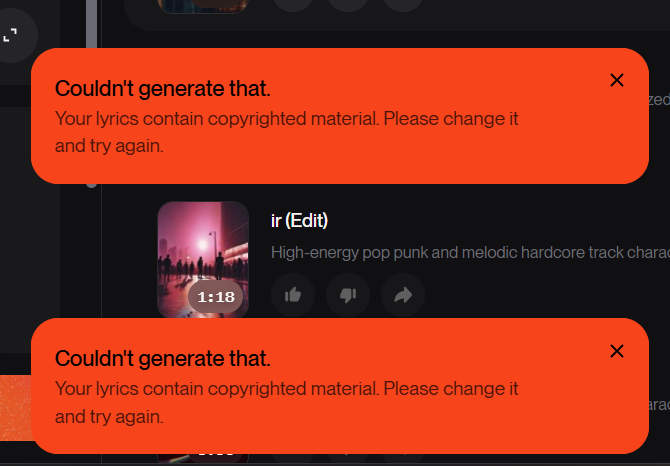
As established in the Verifact forensic capture of the Suno Studio interface, the platform is programmed to identify and block blatant prompts of protected material.

The "Clip Settings" observed in the report include high-precision features such as "Extract Stems" (Vocals vs. Instrumental), "Transpose," and "Speed" modifications. These are not merely artistic filters; they are essential tools for masking a song's digital signature to evade automated identification while retaining the melodic and structural "soul" of the track for subsequent cloning.

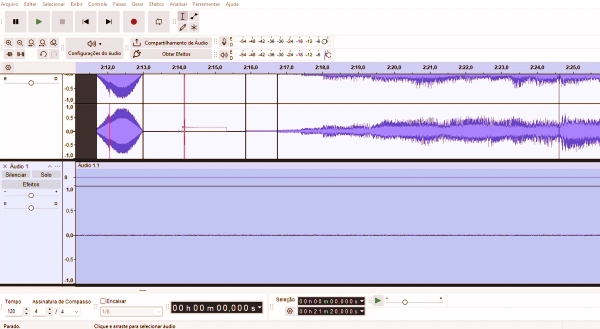
Injection (Upload): In an effort to get around initial filtering, user-submitted files are deliberately distorted. The process reduces audio quality, resulting in sound artifacts and limited audio frequency (Lo-Fi). Complete removal of ID3 tags and structural metadata to prevent header-based detection. Injected high-decibel "burst noise" at the start (head) and end (tail) of the sample. Application of a high-gain noise floor on a secondary stereo channel, kept at sub-perceptual levels for humans but sufficient to distort the AI's waveform fingerprint. Critical manipulation of the fundamental frequency (Time Stretching).

Calculated Derivation (Cloning): After the file is inside Studio, simply cut the initial layers that contain the noise, then select the audio, and without entering a prompt, click the “cover” function (the blue “cover” button) on the Studio interface. The platform’s "Remix" and "Extend" functions utilize the manipulated source as a structural foundation, generating output that is fundamentally derivative of the pre-ingested work.

Check out the videos below to see a few samples:

Ace Of Base

The Sign

Taylor Swift

Anti-Hero

Metallica

Enter Sandman

One of the most legally damning capabilities revealed in this investigation is "digital resurrection". The platform’s ability to reconstruct high-fidelity audio from nulled or degraded sources. Forensic capture (Image 8) shows the AI isolating "Stems" (Vocals and Instrumentals) to identify the underlying melodic structure..

Pattern Recognition and Training Weight Exploitation: The AI’s "generative" capability is a misnomer; it is an optimized retrieval system. When presented with an isolated vocal or a "nulled" track, the architecture accesses its training weights—built on the ingestion of millions of copyrighted masterpieces. The AI then "hallucinates" the missing data by projecting the high-fidelity patterns of the original Lady Gaga "Poker Face" recording it already knows, effectively resurrecting the protected work from an unrecognizable fragment.

The Crime Scene

The Verifact forensic report functions as a digital crime scene, capturing the precise moment identifiable, protected works are replicated. The platform does not merely "generate" music; it facilitates the unauthorized extraction and commercial substitution of established intellectual property.

Crimes Against Content Creators:

  • Unauthorized systematic derivation: Extracting and reproducing protected lyrics through manipulated prompts.
  • Melodic and Timber Exploitation: The commercial appropriation of an artist's unique vocal timber and specific melodic structures for synthetic reproduction.
  • Architecture-Enabled Circumvention: The provision of tools (Stems, Transpose) specifically designed to facilitate the bypassing of the platform’s own safety protocols.
  • Forensic Traceability: As established by the SHA512 verification in the capture, the resulting output remains digitally and mathematically tied to the original protected source.

The Forensic Hammer: Destroying the "Guitar" Defense

The report captures the platform providing the infrastructure for the systematic deconstruction and reassembly of protected works. orensics prove the platform provides specialized 'Stem' extraction tools specifically to facilitate the cloning of ingested audio. Hash SHA512 and SHA3-512 verification confirms that the generated output is a digital derivative tied directly to the original protected source. A guitar does not come pre-loaded with the memory of "Poker Face." A guitar does not generate a melody from "No Input" or provide a vocal stem when the user provides no lyrics. As this investigation proves, Suno AI provides the strings, the notes, and the internal database—the "memory"—of the songs being cloned.

Technical Summary of Evidence: The following forensic metadata establishes the technical chain of custody and the absolute integrity of the evidence captured in this investigation. Identificador: 69ba-936e-6336-6b2c Título: Registro clonagem de musicas Suno AI Responsável: R***** *****es El*** Data de Captura: 18/03/2026 Ambiente: WEBSITE - Suno Studio

Conclusion

To ensure the report's effectiveness in legal proceedings, the document emphasizes the necessity of validation.

Online Validator: Integrity can be verified at https://valida.verifact.com.br/69ba936e63366b2c.

Integrity Warning: Any modification to the digital report or its printing may invalidate the digital signatures. The digital original must be used to verify the SHA-512 and SHA3-512 hashes provided for every captured file.

This report provides a comprehensive, immutable record of interactions with Suno AI, specifically highlighting the platform's internal copyright detection mechanisms when presented with existing commercial song lyrics.

Final Observations and Data Access

The forensic analysis of the evidence collected concludes with a "high confidence" classification of the probative material. The materiality of the infringement is sustained by four pillars: Integrity (cryptographic immutability), Priority (proven existence at a specific date/time), Origin (direct connection to Suno AI servers), and Context (nexus between user login and copyright alerts).

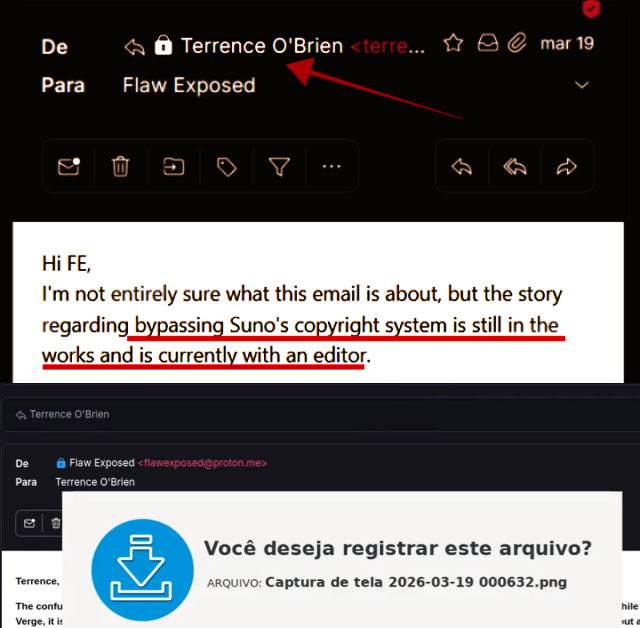
The conduct of Terrence O'Brien transcends editorial judgment and enters the realm of technical negligence. By acting as a private validator of a flaw while omitting it publicly, the journalist abdicates the role of a guardian of truth. The non-publication of the flaw served as a barrier to public scrutiny, allowing AI-assisted piracy to persist without the corrective pressure that investigative reporting would impose.

Given the technical metadata and compliance with international ISO standards, contesting this evidence would require breaking military-grade cryptographic protocols. Therefore, the findings are technically incontestable, providing the legal security necessary for investigative publication.

All digital evidence and forensic files are accessible via Proton Drive or can be sent directly upon request.

flawexposed@proton.me